Violence in the West Bank – Part 1
Sometimes the news is like that clump of pasta, where individual strands get stuck together and it seems easier to throw the whole thing out.
Depending on what media stream you are consuming or listservs you are on, the West Bank settler attacks may not have fully hit your radar. However, you may have heard that Charles Kushner is decamping from New York City to Florida because of what he terms “a hostile environment.” (Gey gezunt!) No one in the tri-state area could miss the Mamdani-Netanyahu kerfuffle — and everyone weighing in on it. Proving Sir Issac Newton’s theory that “for every action there is an equal and opposite reaction,” I got emails informing me that two rabbis I know had released statements critical of Mamdani. Closer to home, I have a neighbor who regularly screams about the Mayor being a terrorist.
Last week, several groups held online talks to bring attention to the horrific violence in the West Bank. Many organizations are currently organizing trips for activists to participate in “protective presence” during the fall olive harvest (October 15–20). I have previously written about the work of Torat Tzedek.
What do all these American-centric stories mean in relationship to the lives of Palestinians trying to survive in the West Bank?
Absolutely nothing.
*
The American Friends of Combatants for Peace presented an online talk called “Resisting Displacement: Non-Violent Tools Against Growing Violence on the West Bank.” Featured were Arafat Abu Rass, a Palestinian activist and a council member of As-Sawiya, and Iris Gur, an Israeli activist involved with the protective presence movement. She was interviewed in the documentary There Is Another Way.
Abu Rass, whose town is near Nablus, described the escalation of violence over the last three years. Coming from a family of farmers, he said, “We will never leave.” He talked about the “need to show the world our suffering.” Surrounded by illegal settlements that began in 1984, the 1994 settlements now occupy 5,000 dunams, or about 1,994 acres.
Focusing on the ongoing tribulations, Abu Rass said, “Every day we have killings.” He spoke about villages where the electricity was cut, and people were deported. “The majority of Israeli Jews now know what’s going on.” Because of the constant aggression, there has been no farming or olive work. On the challenges of non-violence, Abu Rass emphasized, “We need to live in peace. We are innocent people. A very poor village.”
Gur, the mother of three children, gave a succinct opening statement. “I’m sorry and ashamed,” she stated. Explaining that the Jordan Valley activists began a decade ago, she underscored how the brutality had “skyrocketed” after October 7, leading to the necessity for 24/7 shifts. Gur addressed how she uses her “Israeli privilege” to push back against the behavior of the settlers.
Drilling down on what Gur qualified as a triangular plan, she defined it as being spearheaded by the IDF, the police, and the national government. Gur pointed to home demolitions and the destruction of water sources to impede the sustenance of shepherding and agricultural communities. Gur didn’t hesitate to use the term “ethnic cleansing,” adding the phrase describing the motivation as “more land with less Palestinians.” She commented without irony, “It was done to my people.”
Gur continued, “Only the international community can stop it. It’s going on all over the Jordan bank, in Areas A, B, and C.” She delivered a flat statement: “Stop giving Israel money.” On a personal level, Gur spoke about wanting to convey, “You’re not alone. I was, and I am with you.” She paused. “I will not shut up.” Using the Arabic term sumud, which translates to steadfastness, resilience, and perseverance, Gur pronounced, “If they can do it, who am I to do something else?”
40,000 Palestinians have been displaced in the West Bank. Settler acts leading up to these numbers cannot be separated from the actions of the government of Israel. Michael Schaeffer Omer-Man, the Director of Israel-Palestine at DAWN and the previous editor at +972 Magazine, was adamant that the “Israeli state has to be called out.” He also referenced the overview of “settlement trade and economic facts.” He noted that it was easier for the international community to call out actions by settlers when the facts on the ground were that “settler violence and state violence have merged.” Additionally, he cited the United States as “a lynch pin of international power.”
There are 900 checkpoints in the West Bank,” Omer-Man said. Regarding a potential change of attitude if a new government is seated, he articulated, “No one will reverse course outside of non-Zionist parties. There is no alternative vision.”
Almost a week later, Israeli Americans for Justice (IAJ) held a call with over 100 attendees. Titled “Fighting Jewish Terror and Ethnic Cleansing,” well-known Israeli human rights defender Sarit Michaeli was on hand to discuss the situation on the ground, which she characterized as a “hellscape.”
Some backstory. When Trump began his second term, he immediately announced Executive Order 14148 to revoke Biden’s Executive Order 14115, which had “imposed certain sanctions on Persons Undermining Peace, Security, and Stability in the West Bank in Israel-Palestine.” The goal had been to impact individuals and entities through sanctions to stop the flow of money to their activities, as well as through property and visa restrictions.
Michaeli reviewed that weekend’s incident near the Palestinian village of Tell, where Jewish settlers were allegedly on a hike. What resulted was an incident in which 4 Palestinians and 2 Israelis were killed. Various iterations of what took place have been reported. Following up, Michaeli ran down the “destruction of Palestinian herding,” attacks on Huwara, the impact on “rural and urban Palestinian communities” — often with 5 attacks a day. The collaboration with the government in “helping formal expansion” was stressed.
“The impunity of settlers” was a key element in carrying out what Michaeli described as encounters that were “terrifying,” with “sinister forces now at play.” She was clear about the “sense of urgency” in the situation and the need to speak out forcefully.
Shira Ben Sasson, the New Israel Fund director in Israel, addressed the ongoing occupation of Palestinian territory. “We’re occupying another people,” she said. “It’s not good for them. It’s not good for us. We want to block the de facto annexation. We want to build peace plans.” Perhaps one of the most unsettling occurrences she discussed was the impact on Palestinian youth. Ben Sasson related how children were walked to school by activists as barbed wire erected by settlers has obstructed their paths. They also will not “go to sleep unless they know a Jewish person is in the village.”
I wonder when New York City rabbis are going to release a statement on Instagram about the fears and anxieties of Palestinian children.
*
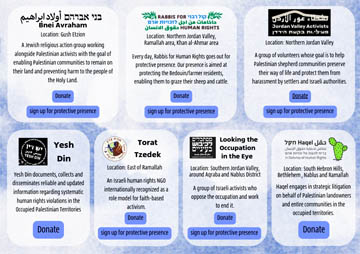
Resources to learn more about trips and financial support for West Bank olive harvest protection actions:
- Truah: Rabbis for Human Rights
- Jordan Valley Activists
- Torah Tzedek
- Looking Occupation in the Eye
- Protect the Harvest
- Friends of Standing Together/Standing Together
- Bnei Avraham (Activist arm of Smol Emuni)
- Good Shepard Collective
- Center for Jewish Non-Violence