Lessons from Montreal
I recently spent four days in Montreal. No, I’m not considering a move. It was a trip with my adult son. I had never been to Canada before, and it was special to speak French daily. I got pegged as a Toronto resident, and when I knew the coast was clear, I admitted I was an American citizen, albeit one who was part of the “resistance.”
The weather was consistently rainy, with the grayness of an early November New York day. That was disappointing, but I had a lineup of museums to visit, so it wasn’t overly problematic. I showed my son that I wasn’t afraid to get on the huge Ferris wheel overlooking the city, and I proved my mettle by walking up to Mont Royal, which is 764 feet above sea level and sits within a park that celebrates Montreal’s skyline.
Yet, my biggest takeaway was the constant reminder of the Indigenous lands on which Montreal was built and the efforts to educate the population and visitors about the history of those peoples. The recognition spanned the earliest days of colonization through the abuse by the Canadian government in the 20th century.
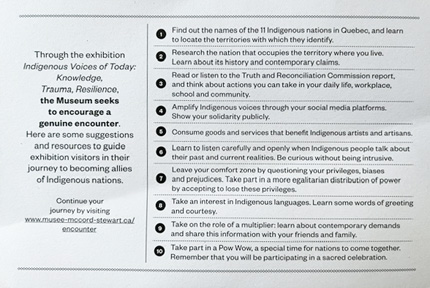
At the McCord Stewart Museum, there was an in-depth exhibition, “Indigenous Voices of Today: Knowledge-Trauma-Resilience.” Printed cards were offered with suggestions for “visitors in their journey to become allies of Indigenous nations.”
Before exploring the individual sections of the exhibit, I read an introductory wall panel that asked, “How can we heal?” The text called for the Indigenous right to “have access to better education” for their children and “healthcare adapted to their culture.” Underscored was the “exploitation of resources on [their] ancestral territories,” which ignores and negates Indigenous “environmental philosophies.”
The statement addressed why numerous “Indigenous voices” have been outspoken about the concept of “reconciliation,” emphasizing that first it must “be preceded by healing.” Clearly delineated was that a shift cannot be established “before a true encounter between the different populations occupying this territory can take place.” At the forefront and essential was “reparation and rebuilding on new foundations.”
The taped personal testimonies were intense, especially those outlining the abuses at state-run schools (in partnership with various church affiliations) whose key mission was to separate children from their families and culture (as happened in the United States and Australia). These “residential schools” were the site of abuse that was emotional, sexual, physical, and psychological, resulting in intergenerational trauma.
There are 1.6 million Indigenous people living throughout Canada, with seventy different languages spoken in 630 communities. “Interrupted and fragmented history” is pointed to, resulting from the “cultural genocide of Indigenous peoples across the entire planet.” Visitors are asked to “embrace the encounter and understand the need for it…in order to work together toward a better future for all.”
The Montreal Holocaust Museum was the only museum open on Sunday, so it had been our first stop. It featured audiovisual presentations, including survivors’ stories, along with extensive artifacts. Before focusing on the World War II period, there was an overview of Jewish life in Canada, with a reference to the Spanish and Portuguese Synagogue, founded in Montreal in 1768.
A large influx of Eastern European Jews began coming to Canada at the beginning of the 20th Century, with continuous waves following. By 1922, 131,000 Jews from the working-class sector had emigrated. They spoke Yiddish, founded schools, created organizations, libraries, and political groups, and built a strong, proactive labor movement. The immigrants brought their version of deli (thickly sliced smoked meats) and developed the “Montreal-style bagel.” (I like New York’s better!)
A section on diverse Jewish global communities, including North African and Sephardic Jewry, preceded the presentation on Eastern Europe and the “Shtetl,” “Berlin,” and the “Initial Persecution of the Jews: 1933-1935.” There was also a nod to “Redeeming the Land,” via a metal charity box for the Jewish National Fund.
In the section labeled “The Persecution Intensifies: 1936-1938,” a statement under the heading “Terror and Obedience” is featured. Unfortunately, the description sounds chillingly like Timothy Snyder’s descriptions of what is taking place in the United States today. (“Nothing less than complete obedience to Hitler and the Nazi Party was tolerated…Every organization in the country complied with Nazi principles or was destroyed.”)
By 1938, the exhibit verifies that 130,000 Jews had left Germany, “In Search of Safety.”
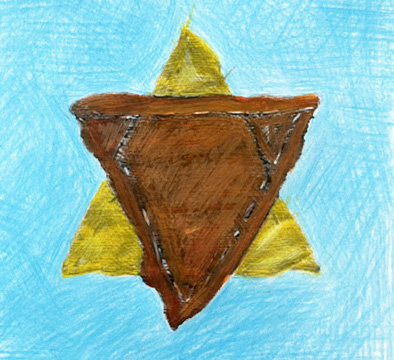
A presentation of Stars of David, each with the word “Jew” written in different languages, was included. One, which looked like an abstract work of art, was a stitched yellow-and-orange piece that left me wondering about its backstory. Perhaps it was made by someone who acquiesced to wearing a star, but insisted on creating one that reflected their own individuality.
The young man at the exhibit’s entry desk spoke with us at length. We learned that he was from Vienna and had been awarded a competitive NGO exchange scholarship, which he chose to replace his year of compulsory service in the Austrian military. Our conversation covered the school classes he had interacted with and other dialogues with the general public. He mentioned that when he had greeted two Hasidic student visitors, they asked where he was from. When he responded, one said to the other, “He’s one of the people who killed us.” Unfortunately, that comment didn’t take into account the Museum’s mission, which, beyond educating the public to the history of the Holocaust, strives to “sensitize the public to the universal perils of antisemitism, racism, hate and indifference.”
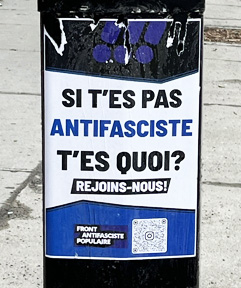
On our second-to-last day, we went to see the Écomusée du fier monde in the Center-Sud neighborhood, which had previously been a working-class area. Housed in an Art Deco bathhouse, it defines itself as “celebrating collective memory and civic engagement.” Not far from the location, a poster had been put up by the Antifasciste Populaire Front, asking, “If you are not antifascist, who (or what) are you?”
The time away from the daily barrage of news that usually fills my days brought some calming relief. However, all the questions I think about ad nauseam remained…Human rights, democracy, global violence, ethnic supremacy, and the rise of authoritarianism.
On our final day, as we walked through the streets, I saw a printed bill affixed to the facade of a black granite building. In italics, it had a quote from Mahmoud Darwish, the Palestinian poet and author who wrote about the Nakba, and the expulsion and exile of Palestinians. A dove with an olive branch was rendered in green, with teardrops in fading red.
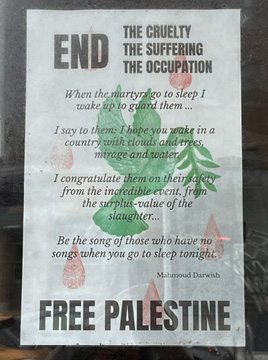
The connective tissue between the three traumas—Indigenous oppression, the Holocaust, and Palestinian displacement—was impossible to ignore. I wondered when a recognition of these histories would lead toward a future rooted in empathy and understanding?
Photos: Marcia G. Yerman