Violence in the West Bank: Part 2-Sonia Marcus
As Jews around the world navigate the period between Rosh Hashanah and Yom Kippur, they have plenty to reflect upon.
The new B’Tselem report, The Elimination Project, digs into “Israel’s Systematic Dismantling of Palestinian Collective Life in the West Bank.” While the ADL is focusing on antisemitism in the United States and elevating Jewish anxiety with their accounts, other Jews are mobilizing for “solidarity presence” actions in the West Bank. The objective is to be with Palestinian communities as they endure assaults from settlers enabled in their actions by the Israel Defense Forces (IDF).
Those involved in protective presence are returning home and sharing their experiences with others in intimate, salon-style settings.
Recently, I listened to Sonia Marcus discuss her experiences on the ground. I also had the opportunity to speak with her in a follow-up interview.
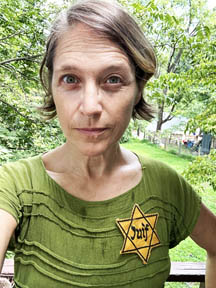
At the presentation, Marcus set up a table with items representing different parts of her story, including a Jewish star with the word Juif. Her maternal grandfather had worn it during World War II. Marcus also had a small ancestral altar, with diverse elements reflecting her personal history.
Marcus began her talk by discussing Hurricane Helene, which hit Asheville, North Carolina in 2024. It was the city where she was living. They had no water for fifty days. Those destructive forces “opened her heart and eyes” and created an internal connection to “front-line disaster work.”
After October 7, Marcus began thinking about going to “the land.” However, she first became involved with a Buddhist delegation, the non-violent action group, Zen Peace Makers. With them, she took part in the Auschwitz-Birkenau Bearing Witness retreat. She saw it as part of her journey, defining a clear social justice connection between what she experienced in Poland and what was transpiring in the West Bank.
During our conversation, Marcus gave me the backstory on her complex familial chronology, which is deeply entwined with the Holocaust.
Marcus’ paternal great-grandfather and his brother left Poland, but made different choices. Her great-grandfather came to America, while his sibling emigrated to Palestine in 1890, in one of the first waves of Aliyah. Her grandfather, Archie Marcus, worked for Louis Marx and Company, the American toy manufacturer. His financial success enabled him to donate large sums to the “project of founding Israel” through fundraisers for the state and Israel Bonds.
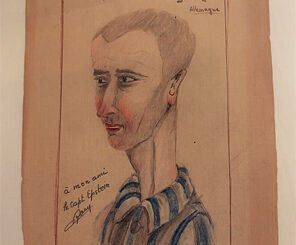
On Marcus’ maternal side, her grandfather was Polish and emigrated to France with his family in 1926. Since Marcus’ grandmother was not Jewish, the marriage created a rift within the family—as well as rejection. The grandfather’s estranged family was deported to different camps because they were not naturalized French citizens.
Marcus spoke of being raised in a Reform Jewish household, with a connection to the Jewish community. She was in the West Bank for part of 2025 and into 2026.
2025 was the worst year for the olive harvest in the West Bank in terms of violence, which has accelerated since October 7. “Settlers have no fear or accountability,” said Marcus. “They act crazy toward activists no matter their age, if they are Jewish, or if they are internationals.” She added that many volunteers involved with working with Palestinians had been “attacked or deported.”
As Marcus defined it, protective presence takes on different forms. Always done in at least pairs, it can mean accompanying shepherds in the field or witnessing and documenting IDF soldiers claiming that the territory they are on is “a military space or zone.” From training in violence de-escalation, Marcus learned the strategy of shftfing the scenario using distraction to refocus the interaction. Nights are particularly difficult.
While contemplating the settler contingent, Marcus offered, “There are all kinds of settlers. Women are part of the movement. Not all are violent, but they are still part of the project.” Her impression of the younger set is that “they are like child soldiers. They are disassociated and want to come off as bad-ass.” Marcus mentioned a Bedouin Palestinian village where families ultimately left their village because they could no longer tolerate the ongoing physical and emotional abuse from the settlers.
“The settlers are terrifying and unpredictable,” said Marcus. She remarked, “Some of them carry automatic rifles.” Since settlers often wear uniforms, and the Israeli military has deputized leaders as “settler security officers,” there is a built-in confusion. Acknowledging that “anyone can get a uniform,” Marcus observed, “They prance around in a uniform because they can.”
Although Marcus emphasized the aggressiveness of the settlers who “run at you with clubs,” she also shared an anecdote about the time when a settler’s ewe gave birth: “It changed the moment between us.” Yet, this was the same person who “could terrorize others.”
Contemplating her own role, Marcus stated, “I feel a personal responsibility. Never have I been so directly implicated. There is a personal connection.” She continued, “In the West Bank I have the ability to influence others, and to encourage them to become part of the movement.”
Pondering the mindset of the settlers, Marcus said, “It’s ironic that settlers quote the Torah, and that Shabbat is the busiest day for them because they consider it holy work.”
Marcus sees how the Holocaust impacted her family as part of her connection to the injustices taking place in the West Bank. Her final thoughts were, “Everyone has their lever to push. It takes time. It needs personal connections. We all have work to do.”
Photo: Courtesy of Sonia Marcus