My Dinner with Gloria: Rembrances from the Women’s Media Center
At her advanced age, I knew it would happen sooner rather than later, but I was still shocked when I saw the news come up on my computer.
Gloria Steinem dead at 92.
It brought back a flood of memories from my time at the Women’s Media Center, founded in 2005 by Steinem, Robin Morgan (who died three days after Gloria), and Jane Fonda.
When I first heard about the fledgling organization, I made an appointment to speak with Carol Jenkins, who was spearheading the initiative from an office housed in the Empire State Building. My angle was that “Women in Art” were part of the “Women in Media” continuum. Our voices had been overlooked as well, and we had something to add to the conversation.
As a “start-up” team began to form, I found myself in a heady mix of ideas, luncheons held to introduce others to the WMC mission, fundraising events for the cause, and occasions structured to get the word out.
Then, I was very much in the art lane. One of my contributions was connecting the WMC with the nascent Feminist Art wing at the Brooklyn Museum. A dedicated gallery was slated to become the permanent home of Judy Chicago’s Dinner Party.
The internet was evolving in new ways, blogging was kicking off, and Fem 2.0 was down the road — empowering women in digital media. There was an explosion of concepts about how to bypass traditional gatekeepers. I didn’t realize then that my stint at the Women’s Media Center would launch a parallel career in writing. At first, it was about “The Activism and Art Connection.” Then, over ten years, my stories for the WMC would include pieces on under-the-radar female activists and arts coverage.
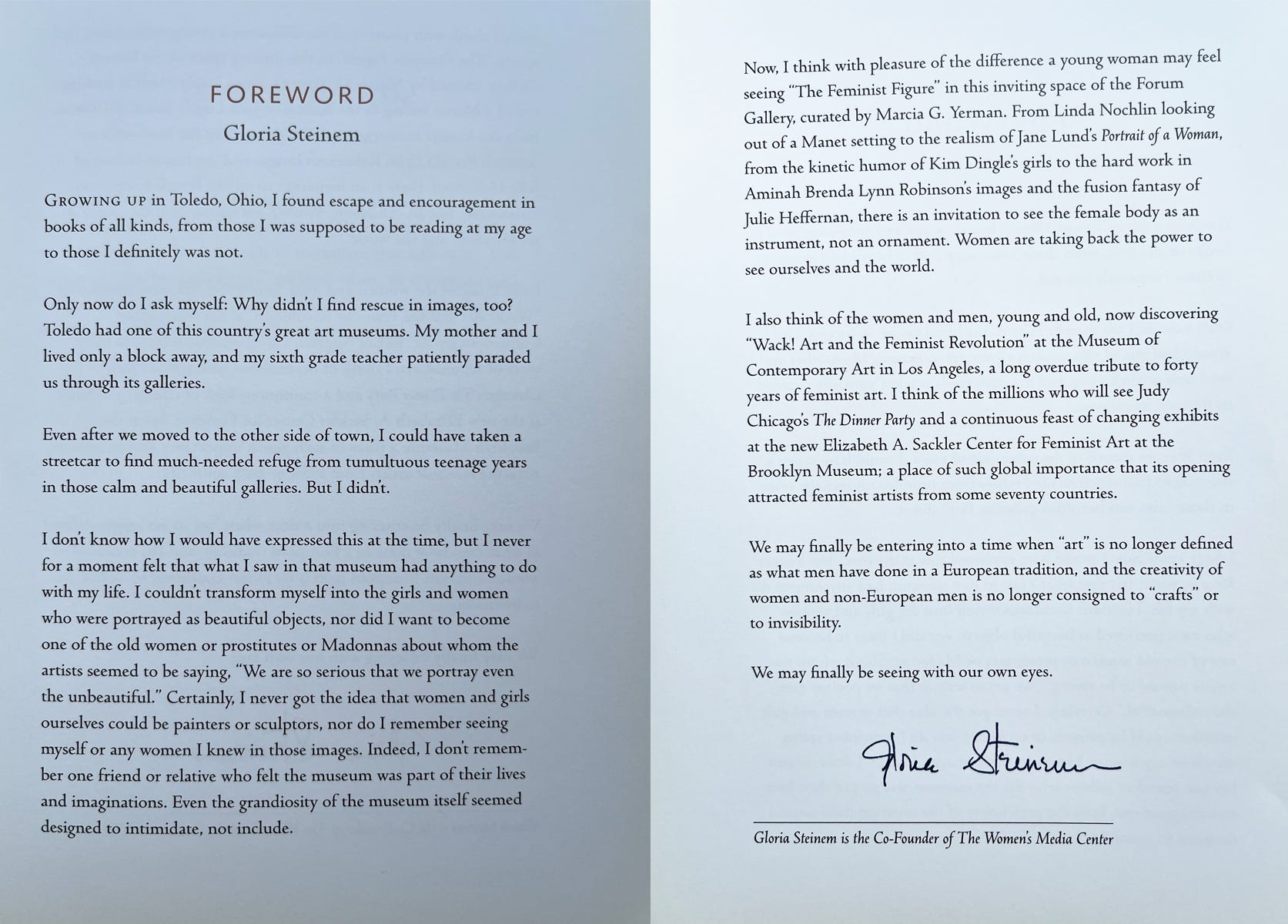
In 2007, I curated the exhibit The Feminist Figure in tandem with The Feminist Art Project, a nationwide grassroots undertaking focused on the work and accomplishments of women artists. That same year, Gloria spoke at the press preview for the Elizabeth A. Sackler Center of Feminist Art and the opening of the exhibit Global Feminisms. It was a special juncture in the art world for women.
Yet, beyond all the functions, the Ms. Gala, and the instance when Gloria personally escorted me over to meet another writer she thought I should know, it is the dinner after a meeting at a female philanthropist’s residence that will remain etched in my memory. Carol Jenkins, Gloria Feldt, Amy Ferris, Gloria, and I went for a bite to eat at a small place with unusual food (I’m a picky eater). The discussion was wide-ranging.
I remained aware, however, that I was on the clock. My eleven-year-old son was waiting for me at my father’s house, and I was expected back by a specific hour.
It wasn’t happening.
I was sitting next to the woman who had given me (and a vast multitude of others) the courage to speak openly. From her, we learned that our reactions to the prevailing culture were not only not crazy — but that we weren’t the only ones who had noticed that something was clearly off. It was a validation that society at large hadn’t previously offered.
Ms. Magazine was the Bible, and carrying it around was the message to whomever that I wasn’t going to take any shit. During that period, if a young woman wasn’t smiling, the question asked was, “What’s wrong? He didn’t call you?” And if you gave a frosty answer, the follow-up was, “Are you one of those Women’s Libbers?” Men felt entitled to pronounce opinions on a lot.
During my first year of art school, I created a plaster of Paris sculpture of a “female dodo bird” with Minnie Mouse shoes. It was my statement on the “patriarchy.” My male teacher was not impressed.
It didn’t matter. I found other mentors, of both sexes. But I don’t know if a generation of women could have done it without Gloria Steinem — along with additional leaders of the feminist movement who told us we were able to.
As I checked my watch, I could imagine my father seething about my lateness. After the meal, when Gloria heard that my destination was near hers, she suggested we take the subway home together.
We walked to the Lexington Avenue line. When we took our seats on the subway, to my amazement, no one recognized her. Perhaps they were lost in their own thoughts. Possibly, they saw her only as an older woman dressed in black with distinctive silver jewelry.
When we got to our stop, we walked up the stairs to the sidewalk and said goodbye.
I ran to my father’s apartment building, prepared for his irritation about my late return. (I didn’t have a cell phone, which eliminated both demands and explanations.) His reaction was as expected, but I didn’t care.
On the way back to our place, my son questioned my behavior and my disregard for returning by the agreed-upon time.
I thought about the best way to explain my actions to him, then asked, “If you had the opportunity to spend time with Derek Jeter, would you have rushed back?”
He looked at me and immediately understood.