Learning About the Nakba
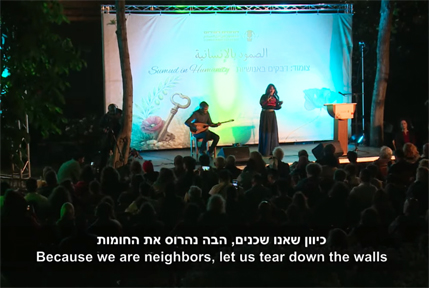
While many American Jews and Jewish legacy organizations were arguing over Nicholas Kristof’s article in the New York Times about the rape and torture of Palestinians (which led to fights over the backlash), I was focusing on the work of Combatants for Peace and the Joint Nakba Ceremony, which was held on May 15.
The previous week, on May 6, Combatants for Peace presented a webinar conversation on the Nakba, with Israeli Jewish and Palestinian speakers. It was a primer on the historical event that has been deliberately pushed under the radar since 1948—for both Israelis Jews and those in the Diaspora, in order to entrench Israel’s origin story.
The speakers included Rana Salman, Dr. Nimrod Ben Zeev, Jamil Qassas, and Avner Wishnitzer.
Salman’s grandparents were pushed out of Haifa and forced to leave everything behind. She is a descendant of what she terms “loss and displacement.” She views the Nakba as “continual.”
Ben Zeev underscored, “It’s hard to overestimate the impact of the Nakba.” He spoke of the 750,000 Palestinians who were expelled or fled their homes, and the communities and villages that were demolished “well into the 1960s.” Ben Zeev related the story his grandmother, a Holocaust survivor, told him. She arrived in Palestine on the Exodus ship. When they got to Haifa, they heard the sound of trucks. It took time before she realized and understood that those trucks were filled with Palestinians being evicted and transported out. Ben Zeev said, “It’s [Nakba] not just an event. It’s an ongoing process.” He noted, “There is no conversation about the Nakba in Israeli society. Israelis see the Nakba as mourning Israeli independence.” He reflected on the “Israeli inability to feel secure” and “trying to sustain what cannot be sustained.” Ben Zeev discussed the level of violence as being commensurate with 1948. “We are very much in the same moment,” he stated. His goal is to “choose humanity and model a different future.”
Qassas discussed the lack of Nakba awareness in Israeli society. He articulated, “There is no teaching of the Nakba in Israeli schools, leading to a disconnect from history.” Qassas expressed his dream for a binational state, asserting, “The right of return is legitimate. The Nakba is a fact—you can’t move forward until you acknowledge the crimes.”
His thoughts dovetailed with Ben Zeev, who emphasized, “The Nakba doesn’t become complete until the right of return is concretized.”
Wishnitzer, who is a co-founder of Combatants for Peace, explained that thirty years ago, he didn’t know about the Nakba, even though ruins of “Palestinian houses dotted Kibbutz lands.” He continued, “The question was never asked, ‘Where did the people go?’” He clarified that “Most of the people ended up in Gaza because they were forced to go south.”
Speaking about the fact that the 1948 Israeli archives still deny what took place, Wishnitzer said, “The Joint Nakba event is a way to break the silence jointly.”
Going back to the reality of how Israelis and Jews around the world were raised, Wishnitzer said flatly, “We were the good guys, erasing everything that didn’t fit that narrative. When you grow up with a sense of moral superiority, it keeps repeating the victim pose.” He pinpointed, “The Nakba is haunting us [Israelis], not just the Palestinians.”
The books of Adam Raz were mentioned as a resource. As Wishnitzer indicated, “Leftist Israelis started with 1967. [Beginning with] 1948 was too scary.” Already speaking out and being branded as traitors, acknowledgment of the wrongs of 1948 was viewed as, “That will undercut our efforts.”
Wishnitzer addressed the call participants directly. He said, “I can no longer not see what I was taught not to see. This is where we need your help. It’s about all of us.”
You can watch the 7th Joint Nakba Remembrance Ceremony here.
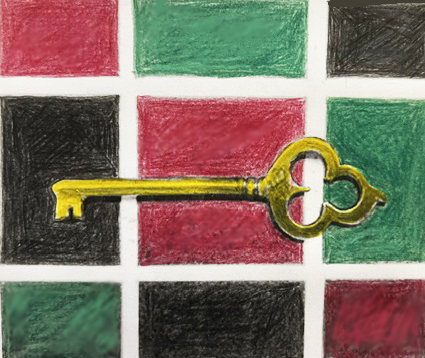
Drawing: Marcia G. Yerman