Deconstructing a Week: From Yom Kippur to Israeli Prison Torture to a Buddhist Coalition
I’m sure that I’m not the only person who thinks that we are living in a crazy world right now. Think Theatre of the Absurd. The week that began with Kol Nidre services included unhinged speeches from the American President and the Israeli Prime Minister. The “Days of Awe” didn’t take long to fade into the rearview mirror.
How to process everything? What to make of it?
The Yom Kippur experience ebbed and flowed. Beautiful music. A prayer for the state of Israel. Sermons warning about antisemitism and Christian nationalism (Calling Mike Johnson). The story of Jonah. I’m sure that everyone in the congregation had a different spin on the words they were reading and the prayers they were intoning.
Two days later, I listened to a day of panels at the Arab Center D.C. Conference (Shifting Tides: Palestine, U.S. Elections, and Pathways Forward). How will the morphing of American public opinion about Israel, the decimation of Gaza, and West Bank settler violence impact the American mid-term elections? What will the Israeli election show the world? If there is an end to Netanyahu, how will new leaders offering solutions based on old themes (the refusal to see Palestinian human rights and the occupation as an obvious element in the equation) make a difference?
During the afternoon discussions, Daniel Levy, President of USMEP, delivered comments with his usual side of wry. He didn’t hesitate to call out “America as an enabler.” On contemplating what change is possible, he noted, “We need strategies.” On Zionism, he asked, “How’s that going for you?” Perhaps his most succinct remarks were, “Israel is in a doom loop” and “The Israel being held up doesn’t exist.”
Where are we here in America? Lara Friedman, President of the Foundation for Middle East Peace, who delivers a weekly round-up of all things legislative, spoke about “building power in Congress.” She underscored how Sen. Chris Coons (D-DE), not exactly a standard-bearer for the far left, had offered a bill to block E1 settlement construction in the West Bank.
Josh Ruebner, with the IMEU Policy Project, gave a primer on the work that Sen. Chris Van Hollen (D-MD) was doing to end “U.S. complicity” as a co-sponsor of the Block the Bombs bill. Ruebner said that the ongoing sending of weapons to Israel was an “outmoded paradigm.” His presentation was a warm-up for the Zoom he would anchor the following day with Van Hollen and other guests.
Meanwhile, on Thursday, Netanyahu spoke at the United Nations. Plenty of people walked out. Palestinian President Mahmoud Abbas was denied an entry visa, so he delivered his address via video. In the streets, a full range of contingents demonstrated their revulsion that Netanyahu was on New York soil rather than in The Hague.
Jewish Voices for Peace held a sit-in on First Avenue. The Palestinian Youth Movement spearheaded a march from Bryant Park up to the U.N., which pulled in other organizations. In Dag Hammarskjöld Plaza, the umbrella Progressive Israel Network had its event.
Social media was filled with documentation of demonstrators calling out different chants: “Israel is a terrorist state,” “Fuck Israel,” “Israel Kills Babies,” and “Israel No More.”
In their midst were clusters of those who were trying to drown out the anti-Bibi slogans, while affirming their complete solidarity with Israel. They responded, “Am Yisrael Chai.”
“The Holding Israel Accountable” event that Ruebner moderated the following day had Van Hollen digging into his Senate Resolution 852, which requested an unclassified State Department report on Israel’s human rights practices. Introduced on September 14, it called for the analysis to be furnished to Congress within 30 days. Over 20 Democrats, including Sen. Bernie Sanders (I-VT), co-sponsored the bill.
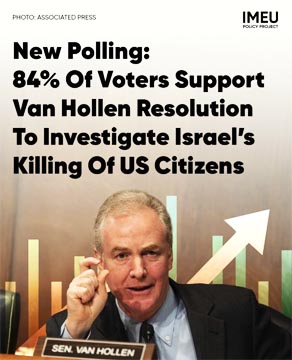
Van Hollen spoke passionately about the deaths of nine American citizens who have been killed over the past four years with “no accountability or justice.” He has met with all the families. There are also three American citizens in Israeli military detention, due to what he defined as a “pattern of false charges.” The resolution additionally requested information on the Palestinian children who are incarcerated. A Data for Progress study conducted in September shows that American voters support Van Hollen’s agenda.
When Ruebner asked why he chose this time to introduce legislation, Van Hollen reflected on the “growing recognition” of facts on the ground. He said he wanted to “use that momentum to focus on these injustices.” Regarding Republican support, Van Hollen stated flatly, “They are completely failing.” He urged American voters to reach out to their elected representatives and make their voices heard on these topics.
Unfortunately, but perhaps not surprisingly, the motion failed. In support were 47 yes votes from Democrats and Sen. Rand Paul (R-KY), and 51 no votes from Republicans and Sen. John Fetterman (D-PA).
Van Hollen is not new to this fight. He has been active since 2020, when he spoke out against Israel’s plans for unilateral annexation of Palestinian territory, and later when he and Sen. Jeff Merkley (D-OR) took a trip in 2025 to investigate ethnic cleansing in Gaza. Van Hollen discussed the one-ton bombs Israel is requesting. “I saw with my own eyes what happened in Rafah.” He continued, “No offensive weapons to the government of Israel. Period.” He closed with, “This is really about universal rights.”
Özden Eygi Bennett, the older sister of Ayşenur Ezgi Eygi, spoke next about her 26-year-old sibling, a Turkish-American social justice activist who was killed in the West Bank. Feeling betrayed by the American government, Bennett described her frustration with the lack of accountability for the death of her sister. Bennett said, “It is my belief that she was directly targeted and killed.” She called for “the sniper and the commander,” who were directly responsible, to be held liable.
John Chappell outlined 502B restrictions. Americans are not aware of numerous laws, including those that are routinely ignored by those in government. When you have power, rules can become dispensable — and there is always a way to navigate an override.
There is documentation of systematic Israeli torture. Chappell described it as “Harrowing reports of torture in Israeli prisons going back decades,” which include beatings, sexual abuse, detention and mistreatment of children, with no medical care.
The implications, if Israel were found culpable, would lead to a “U.S. arms embargo on Israel and no security assistance.” For those who are reticent to acknowledge the findings, believing them to be prejudicial, they can check out the report from the Israeli organization B’Tselem, the Israeli Information Center for Human Rights in the Occupied Territories. It is entitled “Welcome to Hell.”
Chappell insisted, “The U.S. Congress must stand up for the rule of law.” That reality remains doubtful.
I keep wondering what has happened to the Israeli psyche that so many citizens can have become involved in the machinery of a system that engages in torture. It left me with the question, “What’s the point to a Jewish state if there is no morality?”
Thursday ended with me watching a virtual town hall sponsored by The Buddhist Coalition for Democracy (BCD) and Insight Meditation Community of Washington, DC (IMCW). The topic was “The Bodhisattva Path in Action: How Buddhism, Politics, and Social Engagement Serve Democracy.” It featured three speakers. Tara Brach (whose talks I consistently listen to for insights on staying centered while engaged in activist work) cited her work with Israeli and Palestinian peace activists. One of her key points was allowing oneself to take in the pain and humanity of others with compassion.
Dealing with those whose thinking is anathema to yours from a “place of love” is a tall order. Kaira Jewel Lingo referenced her own challenges in response to those whose belief system is diametrically opposed to her own. (That made me feel better.) Ben Connelly, who works in the “intersectional liberation” space, articulated thoughts about applying mindfulness in secular contexts.
After a tumultuous week of intense feelings and contradictions, thinking about the organizations that are doing partnership work in Israel-Palestine kept me grounded.
Activism takes many forms. They are all needed. Hopefully, more people will be able to move forward with an open heart.