Standing With the Peacemakers
While wrangling over the future of Israel’s government is in full swing, the twentieth anniversary of Combatants for Peace (CFP) underscored for me, once again, that true change will come from individuals on the ground. A live-streamed gathering marked “twenty years of courage” and the decision to “work for something different, a different future.” It honored the co-founders of CFP and their choice to “keep choosing partnership,” because “there are always those who dare to go first.”
Sulaiman Khatib, Chen Alon, Bassam Aramin, and Avner Wishnitzer are the four men who saw their futures as “intrinsically intertwined” and committed to “rejecting the prison of hate” while facing the reality that “injustice must be confronted” together, and the occupation must end. Their point was clear: these goals can be achieved only by standing together in what Alon called “the radical intimacy of healing and release.”
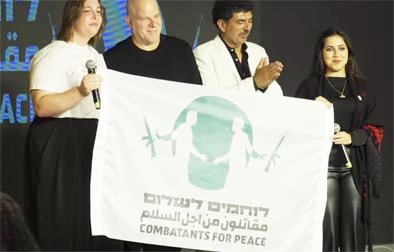
Each man shared aspects of his personal story (I wrote about this when covering the Stephen Apkon documentary, “There is Another Way”). Wishnitzer discussed “Killing people that we didn’t know” and “refusing to play the role written for us.” Aramin, the father of 10-year-old Abir, who was shot and killed by an IDF soldier, reiterated, “Israeli Jewish and Palestinian lives are intertwined.” Alon, who served the Occupation machine for a decade and a half, spoke of the Palestinian youngster who “woke in terror” during an Israeli night raid. He stated, “Combatants for Peace has no finish line,” and pointed toward a “binational culture.”
The hall was filled with Palestinians and Israelis seated at long tables. The event screened a video featuring residents from different locations in the West Bank and the Jordan Valley, and Palestinians spoke about how CFP members’ presence had helped them remain on their land through joint presence actions and a water campaign.
Rana Salaman and Eszter Korányi, the Palestinian and Israeli co-directors, were introduced. Salaman talked of leading a binational effort and moving from “male-dominated leadership to gender-based equality (This was received with big cheers). Salaman noted that “women and children bear the biggest burden on the ground,” and she called for women’s voices as integral to the process of peacemaking.
Growing up in Hungary, Korányi stated that “becoming Israeli meant giving up old narratives and living in a different reality.” She also addressed the need for more women in leadership and, post-October 7, “holding together a binational movement.” She underscored the vision of a new generation of younger activists working in a transformed way: “We do not just dream of a different future, we embody it,” she said.
Clips from people around the world, committed to doing “our share from abroad,” were shown. From Denmark (“Love and kindness are a form of resistance”) to Italy (“Structural injustice in the land”), the Netherlands, and France, the theme was “co-existence through co-resistance.” Israeli-American Gili Getz was on hand, as was Aziz Abu Sarah, whom I saw in person the following week at Manhattan University in the Bronx.
*
The Holocaust, Genocide and Interfaith Education Center at Manhattan University hosted activists Aziz Abu Sarah and Maoz Inon during their American tour to discuss their top-selling book, The Future is Peace. Dr. Mehnaz Afridi, who leads the center, presided over the conversation before an audience of students and community members.
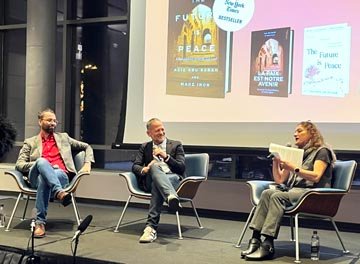
I first wrote about Aziz and Maoz in October 2025, before their book had been published, when they appeared at the Gramercy Park Synagogue in Manhattan. Their warm relationship and easy banter lighten the intensity of the subject matter, enveloping listeners and allowing them to hear their message without the usual anxiety that can accompany talks that dig into issues around Israel and Palestine.
Dr. Afridi had read their book in May and intrinsically understood how important it was to present their message at the HGI Center. She spotlighted their relationship, which Maoz qualified as “A brotherhood. It was meant to be.”
Aziz was 10 years old when his beloved older brother died, the result of Israeli imprisonment and internal injuries sustained from torture. The shock and bitterness led to years of feeling the need to seek revenge. It took him a long time to determine, “You can never change the past. What’s key is, how do you respond?”
Reaching out to Maoz after the murder of his parents during the October 7 attack, Aziz cited how Maoz publicly began to speak out about “the people dying in Gaza in the first week.” Maoz and his five siblings had made a “moral decision” in the aftermath of their tragic loss: “No vengeance.” They determined to “create a different path” based on the example their parents had modeled. Maoz said, “We must overcome fear.”
Dr. Medhi referenced that November 9 was the anniversary of Kristallnacht before asking, “How does inherited trauma impact, and how can we help young people?”
Maoz related that he had no Palestinian friends until he was 30 years old. He explained that his grandparents were “pioneering Zionists who completely ignored Palestinians.” He then asked, “Do we want to keep living within this trauma? This is a choice each of us can make. By humanizing our enemy, we humanize ourselves.”
On the subject of trauma, Aziz added, “We’ve lived through so many wars. It becomes us versus them. The trauma makes trust impossible. It’s always about the next war—not peace. We need to show what’s possible.”
The conversation shifted to work on the ground, specifically the Protect the Harvest initiative, which involved American and Israeli Jewish citizens, international activists, and American clergy under the T’ruah banner. (Hear testimony from Rabbi Sarah Reines here.) The violence perpetrated by settlers with the complicity of the IDF, against those who came to the West Bank to form a solidarity presence for the olive harvest, was vicious.
“Talking about peace is not enough,” said Aziz. “Do the work. Peace is about action.” Referring to the relationships built, Aziz asked, “How many of us are needed to make a change?” He answered his own question definitively. “Americans are part of it. This is why we need your help.”
In the shadow of the American election, Aziz emphasized pushing elected representatives “to stop legitimizing war and weapons.” He stressed, “Why are all our investments in weapons?” Maoz reiterated a phrase I had heard him use previously, directed to “those who believe in justice, peace, and equality—and those who don’t yet.” He was explicit that, by offering a different vision, “We will get there if there are enough of us on the ground.”
Dr. Afridi remarked, “Peace is tough work. You have to acknowledge the pain of the other.”
For Aziz, “keeping one’s political imagination alive” and using creativity to solve problems were key to moving forward. He highlighted that the “new negotiation room has to be different,” adding, “We need women in the room.”
Questions were taken from the audience. One man recounted the differences between the language he and his son were using to discuss Israel and Palestine. Maoz responded, calling upon a need to “Stop with semantics.” Instead, he suggested, “Let’s move into the future and acknowledge the other’s narrative. Two peoples see the land as their homeland.”
“The Nakba, the War of Independence, genocide, war of revenge.” Aziz ran through the litany of terms frequently used and debated. His final advice of the night was: “Don’t silence anyone.”
Photos: Marcia G. Yerman