Lost Voices of the Holocaust: The Art of Marcel Roux
Manhattan University, a Lasallian Catholic university in the Bronx, is home to the Holocaust, Genocide, and Education Center, a gem in the New York metro area. While focusing on the “lessons of the Holocaust,” it names its commitment to “understanding and respecting differences and similarities between peoples of all religions, races, ethnicities, and nationalities.” Led by Mehnaz M. Afridi, whose area of expertise is Islam and the Holocaust, the promotion of Jewish-Catholic-Muslim “discussion and collaboration” is a core premise.
I have previously attended numerous talks and exhibitions at the space. When I saw a reproduction of one of Roux’s drawings, I was anxious to see the presentation. Showcased are twenty-six drawings Roux made in the closing days of World War II. At the opening reception, I had the opportunity to hear comments from those who mounted the show.
The exhibit presents two parallel stories. The first features Marcel Roux, a French political prisoner who was liberated from the Langenstein-Zwieberge concentration camp in Saxony-Anhalt, Germany, one of Buchenwald’s numerous subcamps. Although it was designated as a “labor” camp, due to the extreme conditions, war correspondent John M. Meeklin wrote that it was “a death camp.” He described the 1100 survivors as “barely alive.”
Side by side with Roux’s story, the exhibition additionally highlights the provenance of the works, which were dedicated to Dr. William A. Epstein, who was serving with the 20th Field Hospital of the American Army Medical Corps when the camp was liberated.
They were found in a closet in 1993 by Helene and Ken Orce during the renovation of a house they had purchased in Greenburgh, New York. The drawings, along with photographs, postcards, handwritten notes, and other ephemera, were stored inside a leather case marked, “Capt. Epstein – Please Return 20 Field Hosp.” The Orces notified Epstein’s widow, who was uninterested in recovering the materials.
In 2009, the Orces contacted Yad Vashem and learned that Roux’s drawings were created between April 18 and May 1, 1945, immediately after the camp’s liberation by American forces. Roux’s background was shared. He was born in Arles, France, in May 1904. Before his time in Buchenwald and Langenstein-Zwieberge, he was interned in May 1942 in Sachsenhausen, outside Berlin. His first wife, Marie-Louise Leger Roux, was arrested and deported to Ravensbrück, where she died in 1944.
Orce, who graduated from Manhattan College in 1965 as the recipient of a full scholarship, donated the documentation to the Center. Dr. David Buyze came on board to contribute archival research, thereby providing greater depth of understanding and context for the drawings.
Roux was a French Protestant resistance activist. According to the exhibit, he was not a professional artist, but rather an individual who created a “visual testimony.” The gallery wall panels state that his drawings occupy a “liminal space between documentary and memory.” It posits that Roux functioned as a “survivor artist” creating a “visceral visual testimony” out of “historical necessity.” In recording his immediate memories, Roux’s visual account serves as a form of testimony from “an insider’s view.” Paradoxically, in the camp records, Roux is listed as “kunstmaler,” which is German for “artist” or “painter.”
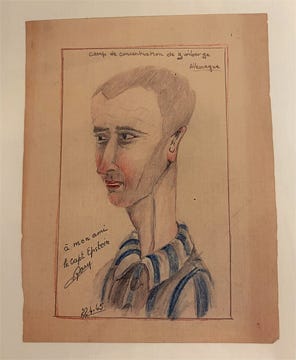
To me, the images did not feel like they were rendered by a novice, even one motivated by an urgent story to tell. They are composed either in graphite or combined with colored pencils. (I pondered where the latter could have come from, and some exploration suggested that they may have originated from the camp’s administrative office.) The color images portray the prisoners in the standard blue-and-white camp uniforms. Faces are rendered with exquisite sensitivity. Cheeks and noses are often accented with strokes of red. The pieces are inscribed, “a mon ami le Capt Epstein.”
Two black-and-white drawings, yellowed with age, capture with full force the brutality of the camps. The first foregrounds a prisoner, whose pickaxe has fallen to the ground. He is raising his arm to protect his face from the blow of an oncoming rifle butt. The attacking soldier has his booted foot on the inmate’s midsection. The background shows another man, his face in shock, while others continue their labors.
The second observes a hanging. Prisoners have been gathered to watch the execution, overseen by two SS officers. All the prisoners’ uniforms carry an upside-down triangle, but there is no way to determine their classification. With the stool overturned and the victim dangling in death, Roux depicts the individual reactions of the assembled witnesses.
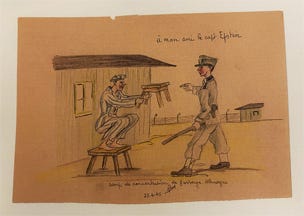
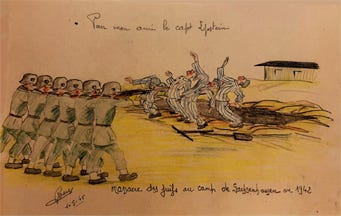
Daily camp life is represented through detailed images: inmates marching in unison, receiving a ladle of gruel, and enduring beatings. One drawing records a prisoner caning another; there is documentation of a man held in a torturous stress position. The work on paper titled “massacre des juifs” (Massacre of Jews) recounts six soldiers, rifles raised, who executed four prisoners who appear to be returning from a work detail. This scene is labeled as taking place at Sauchenhausen.
The exhibition titles Roux’s drawings, “Liberation Art: A Story of Memory and Preservation.” Supplemental text breaks down Roux’s imprisonment through the three camps he survived, with backstory on each. There is also a reproduction of a “Chart of Prisoner Markings” used in German Concentration Camps. It shows how ID-Emblems were employed to designate the prisoner’s identification “category.”
Five “reflective questions” are posted to encourage viewers to engage in a deeper examination of their reaction to Roux’s depictions.
In her remarks to those gathered for the exhibit’s opening, Afridi spoke about creating “a more just and compassionate world rooted in social consciousness.”
She concluded with, “Right now, we need this kind of light.”